

TERMINALES EUROS - TESSELLATION
FICHE DE CORRECTION - TESSELLATION
1. Go on the Internet and find a simple definition of the word tessellation.
A tessellation or tiling of a plane is a pattern of plane figures that fill the plane with no overlaps and no gaps. A tessellation is created when a shape is repeated over and over again. All the figures fit onto a plane / flat surface exactly together without any gaps or overlaps.
2. What does the Latin word tessella mean?
It corresponds to a small cubical piece of stone, clay or glass used to make mosaics. The word means “small square”
3. Find information about the artist who often used tessellations in his work. Fill in the following document.
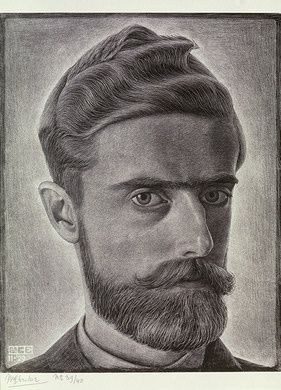
|
LAST NAME : ESCHER FIRST NAME : Maurits Cornelis DATE OF BIRTH: June, 18th 1898 DATE OF DEATH: March, 27th 1972 NATIONALITY: Dutch COUNTRY: the Netherlands
Why was 1922 an important year to him? Where did he go to?
He left school, traveled a lot and visited Italy and Spain.
What was the monument that inspired him most?
Escher was impressed and inspired by a 14th-century Moorish Castle in Granada (Spain), the Alhambra.
Copy and paste different pictures of tessellations in the Alhambra. |
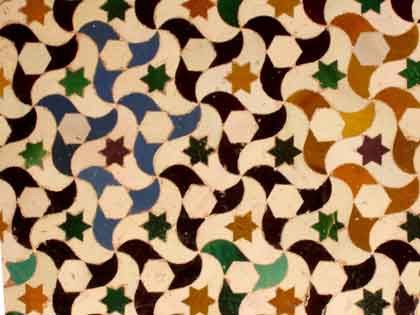
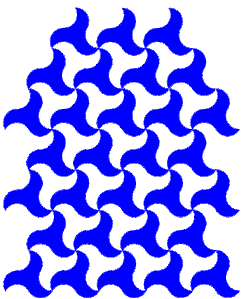
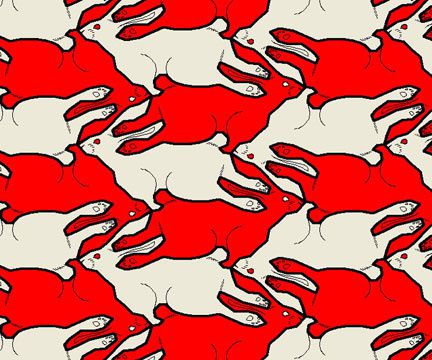
Observe carefully different pictures of tessellations in the Alhambra and read the following definition:
A tessellation is a repeating pattern composed of interlocking shapes (usually polygons) that can be extended infinitely. The tiling for a regular (or periodic) tessellation is done with one repeated congruent regular polygon covering a plane in a repeating pattern without any openings or overlaps. Remember 'regular' means the sides of the polygon are all the same length, and 'congruent' means that the polygons fitted together are all the same size and shape. A semi-regular (or non-periodic) tessellation is formed by a regular arrangement of polygons, identically arranged at every vertex point.
Source : http://mathforum.org/sum95/suzanne/whattess.html
1. Underline the important words in the definition.
2. Take a pencil, a ruler, a T-square and a pair of compasses.
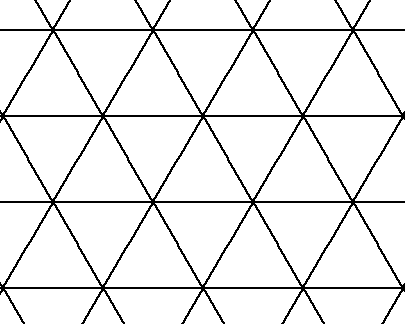
3. Draw a tessellations of triangles.
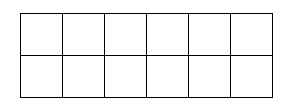
4. Draw a tessellation of squares.
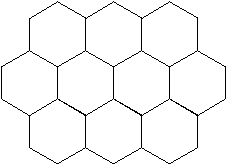
5. Draw a tessellation of hexagons.
Homework for next time: Whether you know it or not, we are surrounded by tessellations!!! Find examples of tessellated shapes in our everyday life.


/image%2F0622041%2F20260817%2Fob_a87cb8_capture-d-ecran-2026-08-17-101955.jpg)
/image%2F0622041%2F20260809%2Fob_edb42d_image-magacity-2.png)
/image%2F0622041%2F20260807%2Fob_f15f86_welcome-in-amc-affiche.jpg)
/image%2F0622041%2F20260614%2Fob_d7654b_couverture-chapitre.png)
